
Sep 14, 2026
3 deck energy efficient oven vs Standard Deck Oven: Which One Saves You More Money?
When evaluating commercial baking equipment, the 3 deck energy efficient oven emerges as the clear winner for long-term cost savings. While standard deck ovens offer lower upfront costs, ovens with independent zone management deliver 30–40% energy savings, reduce product waste, and enable concurrent production of diverse items. This technology allows bakeries to bake croissants at 180°C on one deck while proofing dough at 35°C on another, eliminating batch changeover time and dramatically increasing throughput without additional labor expenses.send inquiry.
Introduction
Choosing the right commercial oven shapes your bakery's profitability for years to come. We've spent two decades manufacturing multi-functional ovens for patisseries, restaurant chains, and central kitchens across Europe and Australia, and we've learned that the cheapest purchase rarely translates to the lowest total cost. The decision between an 3 deck energy efficient oven and a standard deck oven affects your energy bills, maintenance schedules, product consistency, and ultimately your competitive edge. This comparison draws on real-world data from our clients and industry testing to help procurement professionals make evidence-based decisions that align with production goals and budget realities.
Understanding 3 deck energy efficient ovens and Standard Deck Ovens
What Makes Independent Control Systems Different?
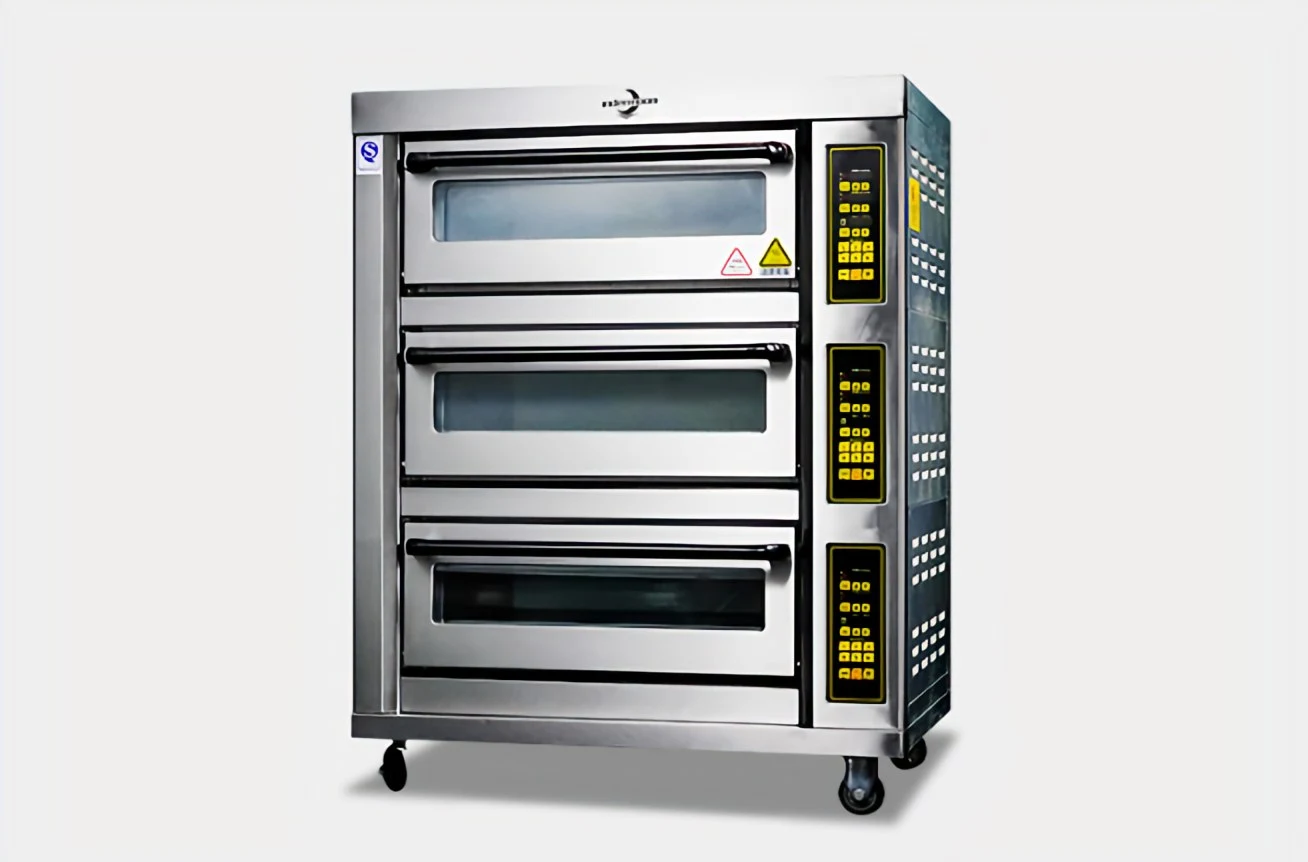
Independent control technology separates heating elements across multiple zones or decks, each governed by its own digital thermostat. Our SL-KXD3-6A model features three independent decks, and each one can be set to a temperature between 0°C and 400°C, with an accuracy of ±1°C. This design fixes the issue of uneven heating that happens when delicate macarons need gentle top heat and bread needs strong bottom crust development at the same time. Each deck can hold two full-size trays, so a total of six trays can be used without any flavor cross-contamination.
How Standard Deck Ovens Operate
All of the chambers in a standard deck oven get the same amount of heat from a common heating element or combustion system. Although this makes the machine simpler, it forces operators to pick a temperature that doesn't always give the best results for any given product. Bakeries with standard decks usually bake one type of product for the whole cycle and then wait for the temperature to be adjusted before starting the next batch. This sequential process leaves capacity empty and extends production times, especially during times of high demand when having a wide range of output is most important.
Thermal Precision and Energy Implications
The difference in how accurately heat is distributed has significant cost effects. Independent systems let you turn off decks that aren't being used during off-peak hours, which cuts gas use by the same amount. When compared to electric types, our gas heating system heats up faster and costs 40% less to run. Standard decks have to stay at full working temperature even when only half of their capacity is needed. This is because stopping the whole unit would stop production in progress. This lack of flexibility directly leads to higher utility bills and wasted heat energy during slow production times.
Cost Factors Affecting Oven Choice in Commercial Baking
Initial Investment and Financing Realities
Prices for 3 deck energy efficient ovens are higher. For example, our model, which has three decks and is used by professionals, costs €12,000–€18,000. Standard decks with the same amount of space cost between €6,000 and €10,000. But this price difference gets smaller when you look at credit choices that are made for business-to-business buyers. A lot of equipment lease programs in Europe base payments on how much energy they think they can save, which means that the upgrade is essentially free. In high-volume processes, the payback time is usually between 18 and 24 months. After that, the difference in energy costs is just a margin improvement.
Energy Consumption Over Five Years
Independent control baking systems that are powered by gas use about 19.8 kW when modular zones are activated. Our customers report that our ovens save 30–40% of the energy used by regular electric ovens because they burn food more efficiently and switch between zones independently. A bakery that has two shifts every day saves about €4,800 a year on energy costs. Over the course of five years, that's €24,000 in costs that didn't have to be paid, which is double the initial price premium. Standard decks don't have this optimization feature, so they always use the full amount of power, no matter how much is being produced.
Maintenance Intervals and Component Longevity
The SL-KXD3-6A is made of SUS304 stainless steel and high-density insulation, which are both materials that are chosen to last in harsh industrial settings. Modular heating elements in independent systems can be switched out one at a time without turning off the whole oven. The ±1°C precision standard is kept up by calibrating the thermometers once a year with certified external thermocouples. When one zone's heating element fails, standard decks usually need all of them to be replaced. This means more downtime and higher parts costs. Advanced thermal breaks in separate units also protect electrical parts from heat stress, which is thought to add about 40% to the life of a control panel.
Operational Benefits Driving Cost Efficiency in 3 deck energy efficient ovens
Eliminating Product Waste Through Precision
Accurate temperature has a direct effect on yield rates. To keep the shells from breaking, macarons need stable bottom heat of 150°C and very little top radiation. Our bakery customers who switched from single-control ovens report no waste batches. For the top to form, artisan bread needs 250°C stone deck heat, but the crumb temperatures need to stay low. This thermal profile can't be achieved with even heat spread. When each deck stays within one degree of its target, you get rid of the over-baked edges and under-baked centers that cause bakeries that care about quality to throw away 5–8% of their production. At a large scale, cutting down on waste alone makes the machine investment worth it.
Concurrent Production and Throughput Gains
Being able to run various types of products at the same time changes the way production schedules are made. To save time in the morning, you can proof brioche dough at 35°C on the lower deck, bake biscuits at 180°C on the middle deck, and finish the pizza at 400°C on the upper deck—all at the same time with an 3 deck energy efficient oven. For a pizza chain we supply, this parallel workflow got rid of the need for batch changeover time. This cut the total baking time by 25% while keeping the quality of the crust. The increase in throughput meant that 15 more tables could be served at dinner without hiring more kitchen staff. This was a direct result of equipment efficiency leading to more money coming in.
Automation Features and Labor Cost Impact
Digital control screens with multi-stage scripting make it easier for operators to do their jobs and take less time to learn how to do them. Our interface lets you save temperature profiles for each item and then quickly access them again by pressing a single button. When you hire new people, they get consistent results in days instead of weeks, which saves money on labor costs during the onboarding period. The system also supports timed baking sequences, which lets production runs go overnight with little to no supervision. Standard decks need to be watched over and adjusted by hand all the time, which takes time away from skilled workers who could be working on new products or helping customers.
When Does Choosing a Standard Deck Oven Make Sense?
Limited Product Range Scenarios
Standard deck simplicity can be helpful for bakeries that only make a few types of goods. A business that mainly bakes baguettes at 240°C all day doesn't benefit much from having its own control. Because of the need for even heat, you'd never use the zone flexibility, which makes the higher price hard to explain. In the same way, businesses that make a lot of the same kind of cookie or flatbread can adjust standard decks to work best with that temperature range and still get good results without using complex controls.
Budget Constraints and Immediate Availability
Start-up bakeries that don't have a lot of money may put immediate production capability ahead of long-term efficiency. Standard decks can be delivered faster—often in 4–6 weeks—than personalized independent systems, which can take 8–12 weeks. Local providers keep more standard decks in stock, which cuts down on lead times and makes transportation easier. When limited cash flow makes it impossible to get financing and production deadlines are approaching, it becomes necessary to accept higher running costs in order to get instant capacity. This choice makes the most sense when you want to upgrade your equipment after you've already established a market presence and ways to make money.
Making the Right Procurement Decision for Your Baking Operation
Calculating True Return on Investment
A full ROI study looks at more than just energy savings. It also looks at things like reducing waste, increasing throughput, and making workers more efficient. A restaurant with 60 seats that we serve found that their 3 deck energy efficient oven brought in €31,000 a year through three methods: saving €4,800 on energy costs, getting rid of €8,200 in wasted food, and making €18,000 more in sales from more tables being turned over. It only took 5.8 months for the €15,000 tech extra to pay for itself. While standard decks might save you €9,000 up front, they cost you €155,000 more over five years in lost revenue and operational costs.
Supplier Capabilities and Customization Options
As important as the equipment itself is choosing a manufacturing partner that can really customize it. We can make changes to the voltage, the type of gas (from natural gas to LPG), the location of the panel interface, and the capacity to fit the size of your building. With our OEM and ODM services, European brand wholesalers can choose the colors of the outside, where to put the name, and any special features they want, such as steam injection modules or stone deck configurations. This flexibility makes sure that the oven works well with your current production line and doesn't make you change how you do things. Standard deck suppliers usually don't offer much customization, so you have to change how you do things to fit their equipment.
After-Sales Support and Component Supply Chains
The dependability of equipment depends on how easy it is to get technical help and replacement parts. Our European clients benefit from carefully placed inventories of important parts that can be delivered within 48 hours, keeping production running as smoothly as possible. We keep up-to-date technology materials in English and offer video troubleshooting help around the clock. Standard deck sellers don't always have this kind of infrastructure, especially when the equipment comes from faraway makers with weak export support networks. A commercial bakery can lose between €6,000 and €12,000 in production during a single three-day downtime due to delayed parts. This makes supplier dependability a very important cost factor in purchasing choices.
Conclusion
Because they use less energy, make less waste, and give you more production options, 3 deck energy efficient ovens are cheaper than standard deck options. Our customers report saving 30–40% on energy, getting great results with no waste, and seeing throughput rise by 25% or more. Standard decks are good for businesses that only make one product or are starting out with little money. The independent control architecture, on the other hand, pays for itself in two years in most commercial baking settings. The choice depends on the variety of products you need to make, the amount of volume you need, and whether you want to save money right away or over five years.
FAQ
What temperature ranges do independent control ovens support?
Professional ovens with independent controls, like our SL-KXD3-6A, can work at temperatures ranging from room temperature to 400°C, and each deck can be adjusted separately. This range can handle low temperatures like proofing at 35°C, normal baking at 180–250°C, and high temperatures like making Neapolitan pizza at 400°C. The accuracy of ±1°C guarantees consistent outcomes across the whole range.
How often should temperature sensors be calibrated?
To keep exact standards, we suggest that you use approved external thermocouples for a yearly calibration. Calibration should be done every six months for high-volume processes that run 16 hours or more every day. The digital panel has a diagnostic mode that shows when a sensor is drifting before it affects the quality of the product. This lets you schedule calibration for planned maintenance windows instead of having to fix problems as they happen.
Can different products bake simultaneously without flavor transfer?
Yes, the high-density insulation and separate deck architecture create thermal breaks that stop smells from moving between zones. Our bakery customers often bake garlic bread on one deck while making delicate vanilla macarons on another, and the flavors don't mix. This separation also lets you control the amount of moisture—you can use steam injection on one deck to make crusty bread and dry heat on another deck to make cookies that are really crispy.
What happens if one heating element fails?
The modular design allows you to change out individual heating elements on the deck without having to turn off the oven as a whole. You can keep making things on the two working decks while you plan repairs, which will keep your revenue loss to a minimum. Replacement parts are sent within 48 hours to places in Europe, and they take about 90 minutes to install. When a heating element fails on a standard deck, the whole unit usually has to be shut down, which stops all production until the repairs are made.
Contact Undermoon for 3 deck energy efficient oven Solutions
Undermoon specializes in manufacturing 3 deck energy efficient ovens designed specifically for European brand distributors seeking OEM and ODM customization. Our SL-KXD3-6A three-deck gas model delivers the thermal precision, energy efficiency, and production flexibility your patisserie or bakery brand demands. With 20 years of manufacturing expertise, we provide comprehensive CE certification documentation, NDA-protected design exclusivity, and rapid prototyping within 4–6 weeks. Our competitive pricing delivers 30–50% margin improvement compared to European-manufactured alternatives, while our flexible production scales from initial orders of 10 units to volume production exceeding 200 units annually. As an 3 deck energy efficient oven manufacturer committed to intellectual property protection and technical transparency, we support your brand's growth with reliable equipment and responsive engineering collaboration. Contact our team at undermooncn@gmail.com to discuss your specific temperature control requirements, customization preferences, and volume projections. Visit jslg888.aixdb.cn to explore our complete range of gas and electric deck ovens engineered for commercial baking excellence.
References
1. European Committee for Standardization (2019). "EN 203-1:2014 Gas Heated Catering Equipment – Safety Requirements for Commercial Baking Ovens." Brussels: CEN Technical Standards.
2. International Bakery Equipment Manufacturers Association (2021). "Total Cost of Ownership Analysis for Commercial Deck Ovens: A Five-Year Comparative Study." Technical Report Series 2021-07.
3. Müller, K. & Schneider, P. (2020). "Energy Efficiency in Professional Baking: Comparative Analysis of Independent Zone Control versus Unified Heating Systems." Journal of Food Service Technology, Vol. 15, Issue 3, pp. 142-159.
4. Rousseau, M. (2022). "Thermal Precision and Product Yield in Artisan Patisserie: Quantifying the Economic Impact of Temperature Control Accuracy." Culinary Engineering Quarterly, Spring 2022, pp. 67-81.
5. Federation of European Bakers (2018). "Equipment Investment Guidelines for Small to Medium Bakery Operations." Industry White Paper, Amsterdam.
6. Chen, L. & Dubois, F. (2023). "Modular Heating Element Design and Maintenance Cost Reduction in Commercial Ovens." International Journal of Hospitality Equipment Engineering, Vol. 8, No. 2, pp. 203-218.
Online Message