
Oct 28, 2026
Commercial Electric Baking Oven: Features, Benefits, and Applications
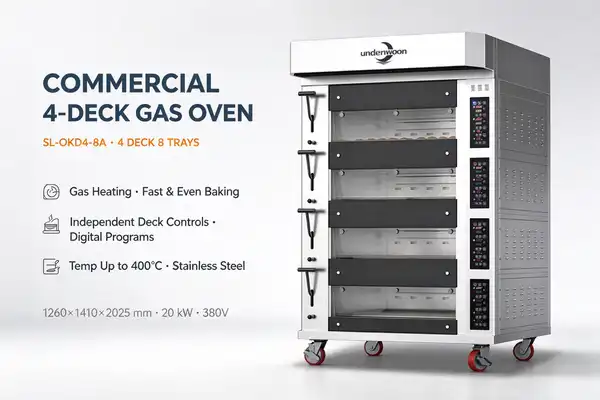
A commercial electric baking oven is a professional thermal processing machine for high-volume restaurant and industrial baking operations. Resistance heating elements provide accurate, repeatable heat, overcoming typical production issues such as uneven baking, sluggish batch recovery, and irregular crust formation. They are not like residential units; they operate constantly in three-shift operations. Our flagship model, the SL-OKD4-8A, has four independent commercial baking oven electrics, eight trays, and digital control for each deck. It’s made entirely of 304 stainless steel – designed for central factories that service 50+ retail locations daily.send inquiry.
Understanding Commercial Electric Baking Ovens: Features and Types
Before purchasing a deck oven, it helps to understand how these machines truly function and what differentiates a production-grade device from an entry-level model.
How Commercial Deck Ovens Generate and Manage Heat
Resistance heating elements are installed both above and below each oven chamber in commercial baking ovens. A PID (Proportional-Integral-Derivative) controller continuously monitors the temperature in real time and adjusts the element output to maintain the setpoints within a tight tolerance, generally ±2°C throughout the chamber. It is this temperature stability that makes a real manufacturing oven different from a restaurant unit.
Types Classified by Capacity and Control Interface
The line of deck ovens starts with a two-deck, two-tray model for the artisan bakery and goes up to the four-deck, eight-tray flagship model for OEM central plants. Control interfaces range from mechanical dials to complete digital computer panels with multi-stage program sets. The top of this line is the SL-OKD4-8A: separate digital control on each deck, a temperature range from room temperature up to 400°C, and a stainless steel structure on casters for flexible installation on the floor.
Safety Features and Compliance Standards
All ovens for manufacturing have to be certified for safety. Other key characteristics include overheat safety circuits, automatic shutdown at preset thresholds, door-lock systems during high-temperature cycles, and multi-layer mineral wool insulation that makes outside surfaces safe to touch. Compliance benchmarks like CE (European Economic Area) and UKCA (UK Conformity Assessed, obligatory post-Brexit) assure that electrical insulation, electromagnetic compatibility, and mechanical safety are all compliant with regional regulations.
Benefits and Energy Efficiency of Commercial Electric Baking Ovens
Once you grasp the technology, the advantages are evident. These are the key advantages that are most important to the individuals who control central plants and who are responsible for purchasing.
- Independent deck temperature control: The SL-OKD4-8A has four decks with their own setpoint. Deck one, 200°C for scones; deck two, 160°C for Danish pastries – no cross-contamination of heat profiles, no lost cycle time.
- Equal heat flow: Insulated, thickened walls and calibrated element placement limit the temperature variation in the chamber within plus/minus 2°C for equal crust color and crumb structure within all eight trays of every batch.
- Fast batch recovery: In a 24-hour central kitchen, 8-12 production cycles per day are the norm, with a 30-second door opening under load followed by a recovery period. A well-insulated commercial baking oven electric will recover to setpoint much quicker than a gas-fired oven with open flue pathways, minimizing the idle time between production cycles.
- Reduced emissions profile – Electric resistance heating creates no combustion byproducts within the kitchen, reducing ventilation needs and increasing air quality for three-shift workforces.
Application Scenarios and Industry Use Cases
The four-deck eight-tray format is the workhorse of large-scale baking logistics. It appears across several distinct production contexts.
OEM Central Factories Supplying Chain Bakeries
A central factory serving 50 or more retail locations needs every batch to be identical — the scone that leaves the oven on Monday must match the one produced on Saturday's night shift. The SL-OKD4-8A handles this by combining multi-program presets (store up to 99 baking programs per deck on the digital panel) with all-stainless construction that resists flavor transfer and holds up under daily sanitization cycles.
Centralized Commissary Kitchens in Food-Service Chains
Large restaurant chains and hotel kitchen groups use commercial baking oven electrics to produce bread rolls, pastry bases, and breakfast items centrally before distributing to individual outlets. The caster-mounted base of the SL-OKD4-8A allows operators to reposition the unit within the facility as production schedules change — a practical advantage in kitchens that reconfigure seasonally.
Industrial Food Processing and OEM/ODM Manufacturing
Food processing facilities that produce packaged baked goods for third-party brands require consistent, documentable output. Our OEM and ODM customization services let these buyers specify voltage configurations (380V standard, adjustable for local grid requirements), deck dimensions, tray capacities, and control panel languages. The result is a machine that integrates directly into an existing production line without floor-plan compromises.
Buying Guide: How to Choose the Best Commercial Electric Baking Oven
Buying the correct deck oven is an investment that will have a long-term impact on both the quality of work and the cost of operating the company. Experienced procurement chiefs tend to place the greatest weight on the following considerations.
Match Capacity to Your Daily Production Volume
A four-deck, eight-tray oven runs 10 manufacturing cycles each day and moves 80 trays of items every 24 hours. Before you choose a model, match it to what you desire per SKU. Too little implies you need to run two shifts; too big means you use too much floor and capital space. The SL-OKD4-8A has dimensions of 1,260 × 1,410 × 2,025 mm; thus, it can be installed in a typical production bay without the need for structural adjustments in most plant layouts.
Evaluate Certifications Against Your Target Market
Post-Brexit, if you wish to sell to the UK, you will need to get UKCA accreditation. The UK market is not served by CE anymore. Ensure that the provider you are considering can provide either the original UKCA certificate or statement of conformity. Also, ensure they will accept third-party audits throughout the approval process.
Total Cost of Ownership Beyond Purchase Price
An international deck oven will often cost 40–60% less than local brands such as Mono or Baxter. But the total price includes import VAT (20% in the UK), sea freight (approximately 35 days from manufacturer to port), local warehouse spare parts, and labor to set up the oven. You can cut those expenses by using suppliers that you can trust to have fast-wearing parts in stock locally and that will send a technician to the plant site for the first three to five days of production.
Conclusion
An industrial commercial baking oven electric with 4 decks and 8 trays is a manufacturing equipment, not something to purchase. If you acquire the suitable unit, make sure it is properly certified, and make sure you can obtain replacement parts locally; it will perform dependably for years during 24-hour shifts. What is vital to a central plant when they make a purchase is what the SL-OKD4-8A offers: digital multi-program panels, autonomous management of the deck temperature, and a provider that works with both the UKCA and CE certification procedures. If you are considering buying a deck oven for a high-volume company, you will be able to make a solid decision by checking out the specs and support system in this article.
FAQ
1. How often should a commercial deck oven be serviced?
If you have a business unit that works two to three shifts a day, check the door seals and clean the burner ports or element surfaces once a month. Every three months, use a NIST-traceable reference probe to calibrate thermocouples. Every year, you should do a full electrical shielding (HI-POT) test. By sticking to this routine, you can keep the temperature within the acceptable range and avoid unexpected downtime.
2. What is the realistic energy consumption of a four-deck commercial oven?
The SL-OKD4-8A can handle 20 kW. At full load on all four floors, you can expect to use 18–20 kWh of electricity every hour during peak output. As the PID controller lowers the duty cycle of the elements to keep the setpoint temperatures, the standby draw drops by a large amount between batches.
3. Can the oven be retrofitted into an existing kitchen without structural changes?
Yes. The base with wheels lets you move it around without having to fix it to the floor. The main equipment need is the 380V three-phase link. The voltage can be changed to match the requirements of the local power supply. To let heat escape properly, the ceiling should be at least 300 mm above the 2,025 mm unit height.
4. Is on-site commissioning support available?
Yes. We send trained technicians to the site to do 3–5 days of on-site commissioning, which includes checking the installation, calibrating the baking program, and training the operators. This is especially important for businesses that make specialty goods like British scones or sourdough loaves, where baking styles need to be tweaked.
Get a Quote from Undermoon — Your Trusted Commercial Baking Oven Electric Supplier
Undermoon has been making industrial deck commercial baking oven electrics for 20 years for central factories, bakery chains, and food processing plants in six countries. Independent deck control, a full stainless steel build, and digital program management are all features that our SL-OKD4-8A has that high-volume operations need. Get in touch with us right away to get price information, OEM specs, or licensing paperwork. You can email our purchasing team at undermooncn@gmail.comto see the full catalog of products.
References
1. British Baker Magazine — Commercial Bakery Equipment Review, 2023.
2. Food Equipment News — Energy Efficiency in Commercial Deck Ovens, 2022.
3. NSF International — NSF/ANSI 4: Commercial Cooking and Hot Food Storage Equipment Standard, 2021.
4. UK Conformity Assessed (UKCA) Technical Guidance — Office for Product Safety and Standards, 2022.
5. Journal of Food Engineering — Thermal Uniformity in Multi-Deck Commercial Ovens, 2020.
6. Foodservice Equipment & Supplies (FE&S) — Buyer's Guide to Commercial Baking Ovens, 2023.
Online Message
YOU MAY LIKE
High quality furniture manufacturer


