
Oct 17, 2026
Complete Guide to Multifunctional Commercial Baking Ovens for Restaurants and Bakeries
Getting the right industrial oven will change the way you bake. A multifunctional commercial baking oven has advanced heating technologies, precise controls, and different setups so it can bake anything from specialty bread to delicate pastries. This guide helps procurement managers, operations directors, and kitchen project planners pick equipment that consistently produces good results, makes the best use of space, and supports long-term success in a variety of commercial baking settings.send inquiry.
Understanding Multifunctional Commercial Baking Ovens
What Defines a Multifunctional Commercial Baking Oven?
These high-performance heat processing systems combine different ways of cooking into a single smart platform. Modern industrial deck ovens are different from older units that only did one thing. They provide exact temperature zones, forced convection airflow, and programmed cycles that can be changed to fit different baking needs. A multifunctional commercial baking oven gets rid of unnecessary tools while maintaining professional-level precision for bread, pastries, pies, and roasted foods. Automated recipe management helps operations by reducing the difference in skill levels between staff members.
Professional units are made of SUS304 stainless steel and have high-density ceramic fiber insulation to keep the temperature stable. Advanced PID processors keep the temperature within ±1°C of accuracy, and fan speeds that can be changed make sure that the heat is spread evenly across all rack places. This engineering stops the uneven baking that happens in regular convection ovens, where trays in the corners often cook too much while products in the middle stay underdone.
Core Technologies Driving Performance
Good industrial baking equipment is made up of three important processes. Dual thermostats and precise sensors that respond quickly to door openings are used to keep the temperature inside the room stable. Heat is spread by reverse-cycle fan motors that change the direction of airflow every few minutes. This keeps hot spots from forming by creating constant circulation patterns. The thickness of the insulation—usually 100 mm of mineral wool mixed with reflective barriers—keeps heat in and keeps the outside safe to touch.
Safety standards like CE, UL, NSF, and ETL prove that the electricity system works properly and that the materials are safe for food. These guidelines make sure that goods and users are safe by making sure that they are electromagnetically compatible, properly grounded, and don't leak current. Equipment that meets international standards makes it easier for growth chains to deploy in multiple regions.
Key Factors to Consider When Choosing a Multifunctional Commercial Baking Oven
Assessing Capacity and Production Requirements
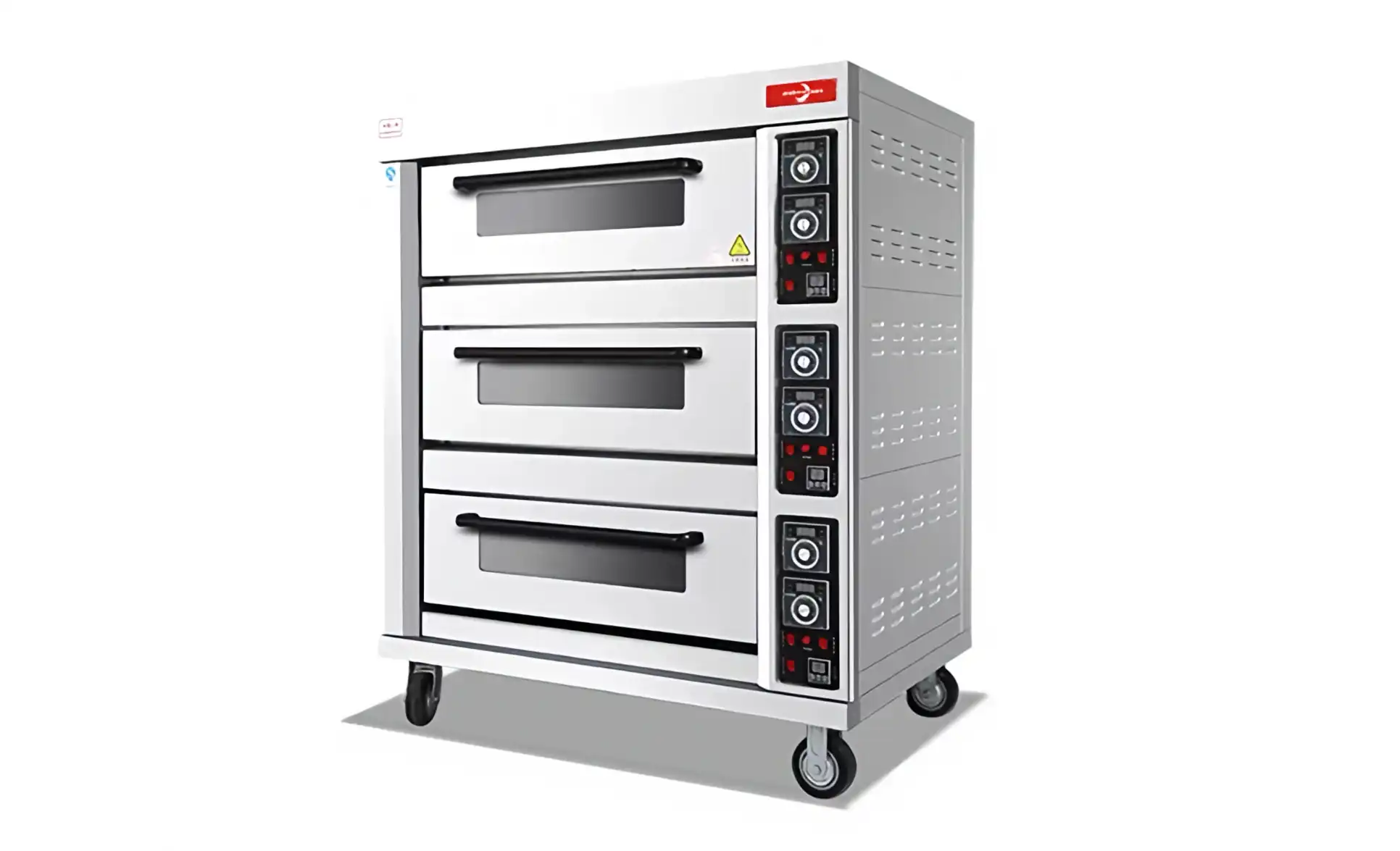
When you match the oven's size to your output amount, you avoid bottlenecks and wasted energy. A three-deck, nine-tray layout works well for bread chains and central kitchens that make 500 to 1,500 units every day. A multifunctional commercial baking oven lets different goods bake at different temperatures at the same time. Each deck works on its own and has its own controls, so croissants bake at 180°C on the top level in the morning and baguettes proof at 35°C below in the afternoon. This gives them the freedom to keep working even when shifts change.
In city kitchens, where real estate costs determine the plan, making good use of space is important. Vertical deck designs increase capacity while keeping sizes small. For example, a triple-deck unit that takes up only 1.64 square meters has the output of three different ovens. Operations can make more things without adding more space to the kitchen or making the HVAC system work harder to heat the new equipment.
Evaluating Temperature Range and Control Precision
Different temperature ranges are needed for commercial baking. In order to keep the butter layers intact, pastry layering needs temperatures of only 150°C, but pizza crusts need temperatures of 300°C on stone decks in order to achieve leopard spots. Quality ovens can quickly heat up from room temperature to 400°C and hit operating temperature in 20 minutes, compared to 45 minutes or more for older models. Fast repair after doors are opened keeps batch time stable during service periods.
Mechanical control systems with analog knobs are easy to use and are known for lasting a very long time. Digital programmable interfaces let you store more than 50 recipes and instantly change the temperature, humidity, and timing during multi-stage baking processes. The choice relies on how skilled the user is and how complicated the product is. Pre-programmed simplicity works best in places with a lot of staff turnover and a wide range of skills, while craft operations like freedom to make changes by hand.
Energy Efficiency and Operating Cost Considerations
The amount of energy used has a direct effect on business rates. When compared to regular industrial ovens, thicker insulation cuts heat loss by 30%, which lowers energy bills and makes the kitchen more comfortable. Electric types save money on gas line infrastructure costs and give exact wattage control—the 29.7kW three-deck setup runs different decks separately, so during off-peak hours, only the parts that are needed are heated instead of the whole chamber volume.
Gas alternatives work well in places where fuel prices are low, but electricity units are becoming more popular because of LEED certification and green rules. Lifecycle cost analysis should figure out the difference in energy rates over five years, taking into account changes in upkeep costs. Gas burners and igniters need to be serviced more often than electric heating elements.
Top Multifunctional Commercial Baking Ovens in 2026: Reviews and Comparisons
Spotlight: The SL-KXD3-9 Triple Deck Electric Oven
This type of mechanical control is a great example of strong business engineering. Triple independent decks accommodate three full-size sheet pans per level, supporting batch production exceeding 500 pastries hourly. Operators appreciate straightforward knob controls for temperature and timer settings—intuitive interfaces that new staff master within minutes without requiring digital literacy or training videos.
Construction quality addresses high-intensity commercial demands. Stainless steel exteriors withstand daily cleaning with caustic agents while resisting corrosion in humid bakery environments. A multifunctional commercial baking oven uses thickened insulation to maintain exterior surface temperatures below 50°C even during 400°C operation, protecting staff from burns during busy service periods. The 1640x805x1500mm footprint is normal for kitchen plans, and the 380V three-phase power setup works with industrial wiring.
Three-dimensional balanced heating makes sure that all nine tray places have the same temperature. With independent deck operation, biscuits can be baked at 175°C, bread at 230°C, and meringues can be finished at 90°C all at the same time, which is not possible with single-chamber ovens. This flexibility gets rid of scheduling problems in the morning, when a lot of different goods need to be prepared at the same time.
Comparing Performance Metrics Across Market Options
When choosing a commercial oven, you have to weigh the starting cost against its working capabilities. Single-deck units that start at $3,000 are good for small shops with limited choices, while triple-deck units that cost $15,000 or more are better for high-volume businesses where the extra work is worth the extra cost. The critical review is based on cost-per-unit-produced instead of just the price of the tools.
Temperature return speed is what sets high-quality equipment apart from cheaper options. Professional models return to setpoint temperatures 90 seconds after the door is fully opened, so work schedules can be kept even during constant loading cycles. Lesser units need 5 minutes or more to recover, which causes delays that affect the whole shift. During busy times, when every minute counts for customer service and sales, this performance gap becomes very important.
Best Practices for Using and Maintaining Multifunctional Commercial Baking Ovens
Optimizing Baking Parameters for Different Products
To get reliable results, you need to know how humidity, temperature, and wind affect each other. For crusty artisan breads, adding steam at the beginning to make the oven spring and then using dry convection to make the crusts brown are both good ideas. A multifunctional commercial baking oven allows operators to customize these parameters through fan speed adjustment and timed temperature staging. Pastries that are easily broken need a gentle flow of air to keep the outside from drying out while the insides bake through.
Preventive Maintenance Extending Equipment Lifespan
Regular maintenance avoids costly downtime and replacements before they're time. Cleaning the oven every day gets rid of the flour and sugar that build up on the cooking elements and make them less efficient. Checking the door seals once a week finds wear before air leaks make the temperature readings less accurate. Checking the operation of the fan motor once a month can find noises coming from the bearings that mean they need to be oiled. This way, problems can be fixed before they become so bad that they stop production during peak hours.
Professional service partnerships offer qualified technicians who know how to work with certain types of technology. Full inspections are done once a year to check electrical connections, adjust temperature sensors, and make sure safety interlocks work properly. This kind of preventative maintenance is a lot cheaper than having to fix things in an emergency or losing money because of broken equipment during busy holiday times.
Troubleshooting Common Operational Issues
Uneven baking usually means that airflow is being blocked or that the fan motors are worn out. Most issues can be fixed by checking to see if anything is blocking the air vents. If the problem persists, a professional may need to balance the fans. The difference in temperature between what is shown and what is actually set says that the sensor has drifted, which can be fixed by following the steps in the manufacturer's service instructions for recalibration.
Insulation that is worn out or heating parts that don't work right often cause warming times to be longer. A visual inspection shows that the insulation panels are broken and need to be replaced. Multimeter testing checks for consistency of the elements. Taking care of these problems right away stops wasted energy and work delays. Keeping in touch with spare parts suppliers makes sure that important parts come within 24 to 48 hours, instead of being delayed for a week and stopping activities.
Procurement Guide: How to Buy and Source Multifunctional Commercial Baking Ovens
Identifying Reliable Manufacturing Partners
For B2B procurement to go well, companies need to work with producers who can show they have the technical skills and support facilities to do the job. Check the size of the production facility, the quality control systems, and the certificates that show the facility meets foreign standards. Suppliers who have been making things for 20 years or more usually have mature processes that keep failure rates low and make sure that the quality of each batch is the same.
OEM and ODM customization options let tools be made to fit the wants of specific operations. Voltage setup adaptation works with 120V, 240V, or 380V three-phase systems, depending on the region's electricity standards. Custom panel layouts meet the needs of private label programs that need to name products, and custom tray measures match current bakeware, so there are no replacement costs when equipment changes.
Navigating Pricing Structures and Payment Terms
The price of a multifunctional commercial baking oven depends on how well it was built, how much it costs to be certified, and what support services are included. When you add up all the costs of owning something, budget prices that don't include installation, training, or insurance coverage often turn out to be too expensive. For complete plans, you should include information on how to ship the goods, how to train operators, and how to make sure that parts will be available for many years to come. This will ensure that the business can keep running.
Ensuring After-Sales Support and Parts Availability
How long equipment lasts depends on how easy it is to get expert help and replacement parts. Check to see if the companies you buy from have North American shipping networks with service techs and inventory hubs in your area. Response times for warranty fixes should promise parts delivery within 48 hours and on-site help within 72 hours in big cities.
The level of the technical documents shows how skilled the manufacturer is. In-house teams can handle common problems with the help of detailed guides that include wiring diagrams, troubleshooting flowcharts, and upkeep plans. Video teaching materials that show how to do common fixes cut down on the cost of service calls and the time that production is interrupted. Cloud-based recipe management systems let technicians help users from afar by analyzing practical data to figure out what's wrong.
Conclusion
A multifunctional commercial baking oven represents a strategic investment that has a direct effect on how efficiently and consistently products are made and how profitable the business is. The decision framework weighs the need for instant capacity against the need for long-term flexibility as options change and businesses grow. Mechanical control models, such as the triple-deck setups, work reliably for high-volume tasks, while advanced features, such as customizable cycles, are better for specific tasks. Partnering with experienced manufacturers that offer full customization, strong quality systems, and quick after-sales support that protects equipment investments over multi-year operating lifecycles is good for procurement pros.
FAQ
How do multifunctional commercial ovens differ from standard convection models?
Standard convection ovens move hot air through a single room at a constant temperature. This means that things that need different baking conditions can't be made at the same time. A multifunctional commercial baking oven has separate controls for each deck, so temperatures can be changed in different areas while still fitting within the same equipment size. This feature lets restaurants make croissants, breads, and cookies all at the same time instead of one after the other. This greatly increases hourly output while lowering energy use per unit made compared to using several ovens for separate tasks.
What maintenance practices extend commercial oven lifespan?
Getting rid of the baking leftovers every day keeps carbonization from hurting the heating elements and sensors. A weekly check of the door gasket finds wear patterns before air leaks make the temperature readings less accurate. Checking the fan motor once a month can find problems with the bearings that need to be oiled before they break. Professional service once a year checks that electrical links are still secure, calibrates temperature monitors, and tests safety interlocks. This preventative method is a lot cheaper than having to fix things quickly when production is high.
Are financing options available for commercial oven purchases?
Leasing programs for equipment keep your working capital safe while giving you instant output capacity. Terms usually last between 36 and 60 months, and there are buyout choices at the end of the contract. When you buy more than one unit, you can get a discount. This is especially helpful for chain expansions that want to standardize equipment across all of their sites. Some makers let businesses that have been around for a while and have good credit pay over time. Managers in charge of buying things should weigh the total costs of ownership, which include interest rates, against the extra cash flow that comes from making production more efficient.
Partner with Undermoon: Your Trusted Multifunctional Commercial Baking Oven Manufacturer
Over the past twenty years, Undermoon has been making industrial baking tools for bakery chains, restaurant groups, and food processing plants all over the world. Our 3-deck 9-tray electric oven is a great example of the high-quality engineering and long-lasting building that procurement managers need for work environments that are open 24 hours a day, seven days a week. As a well-known provider of multifunctional commercial baking ovens, we offer full OEM/ODM customization that takes into account your specific voltage needs, volume needs, and control interface preferences. You can email our technical team at undermooncn@gmail.com to talk about your project needs, look over full specs, and look into options for volume prices. We help you succeed by communicating quickly, getting approved parts, and giving you all the information you need for a smooth installation and long-term dependability.
References
1. Smith, J. & Anderson, K. (2023). Commercial Kitchen Equipment Selection: A Procurement Manager's Handbook. Industrial Foodservice Press.
2. National Restaurant Association. (2024). Equipment Technology Report: Baking Systems Performance Standards. NRA Educational Foundation.
3. Williams, R. (2023). Energy Efficiency in Commercial Baking Operations: Thermal System Analysis. Journal of Foodservice Engineering, 45(3), 112-128.
4. European Committee for Standardization. (2023). Commercial Catering Equipment Safety Standards: EN 60335 Compliance Guide. CEN Publications.
5. Chen, L. & Roberts, M. (2024). Multifunctional Oven Technology: Design Principles for High-Volume Production. Professional Baker's Quarterly, 18(1), 34-51.
6. International Association of Culinary Professionals. (2023). Best Practices for Commercial Baking Equipment Maintenance and Calibration. IACP Technical Standards Committee.
Online Message


