
Oct 30, 2026
How to Choose the Best Commercial Electric Convection Oven for Your Business?
The first step in choosing the best convection electric oven commercial unit is to match the output needs of your kitchen with the actual capabilities of the oven. The incorrect option means you lose time, money, and consistency of output. For a network of boutique bakeries or a central production kitchen, it’s about five things: how the oven warms, what certifications it has, how many programs it handles, what the supplier can modify, and what the after-sales coverage is. The handbook explains each element in plain language.send inquiry.
Understanding Commercial Electric Convection Ovens
Before you compare ovens, it's helpful to know what makes a commercial-grade unit different from a regular one.
How Forced-Air Circulation Works
An industrial convection oven has rapidly moving fans that circulate hot air over all the racks at the same time. The chilly layer around the meal is taken away so the heat may distribute more quickly and effectively. Research published in the ASHRAE Journal on airflow in commercial kitchens corroborates the finding that forced-air ovens cook food 25-30% quicker than static radiant versions. This is really handy when you need to bake several units per shift.
Key Components to Evaluate
The fan motor, the heating element or burner system, and the control panel are the three components that will make or break the machine over time. Heavy-duty fan motor bearings should be covered so that they can withstand dirt and water. The heating elements should be covered with a rust-proof metal. I think there should be a different option on the controller for each deck. This is crucial when you need to bake baguettes at 230°C on one level and have the dough rise at 38°C on another.
Convection vs. Conventional Deck Ovens
The heat is transferred via a stone or steel plate in acommercialconvection electric oven. Acommercial convection electric oveninvolves the movement of air around the meal, which alters its form. This results in a lighter crust with a more uniform tint all around. Deck convection electric oven commercialsare mostly used for baking fresh bread with a thick crust. For multi-SKU batches, cakes, pies, and other high-volume activities that need consistent browning over six trays at once, employ convection or multi-deck gas-electric hybrid equipment.
Key Factors to Consider When Choosing a Commercial Electric Convection Oven
Capacity, temperature range, certification, and material quality are the four pillars of every sound purchasing decision.
Capacity and Tray Configuration
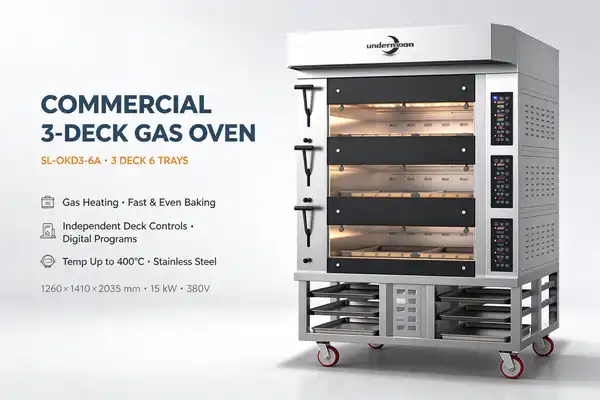
The batch output each cycle is directly proportional to the number of trays. The SL-OKD3-6A (1260 × 1410 × 2035 mm) 3-deck, 6-tray device can handle six full-size sheet pans at once. For a network of 30+ sites that has daily supplies from a central kitchen, this setup decreases production cycle times and manpower per unit baked.
Temperature Range and Digital Precision
Select a device with a minimum ambient range of 400°C and digital controls accurate to ±2°C per deck. Each chamber has independent panel settings, allowing bakers to run multiple items concurrently without flavor transfer or cross-contamination of temperature zones. At least 10 programmed recipe presets are worth having; this alone cuts operator error during busy hours.
Certification Requirements for Your Market
All North American operators must validate ETL or NSF/ANSI 4 certification before making any transaction. CE certification meets European safety standards but does not substitute for U.S. market regulations. If procurement directors don’t do this check, they risk having equipment refused at customs or highlighted during health inspections. Always ask your provider for comprehensive certification paperwork before paying any deposit.
Material and Insulation Quality
304 stainless steel inside and out that resists corrosion, withstands industrial cleaning agents, and maintains structural form throughout everyday temperature cycling. High-density mineral wool insulation decreases heat loss via the surfaces, reducing energy demand and protecting kitchen personnel from burn danger. Aluminum interiors are cheaper to buy initially but wear out quickly in busy commercial convection electric ovenareas.
Comparing Commercial Oven Configurations in 2025
The market is split between tiny single-deck countertop devices, mid-range two-deck floor units, and full-scale three-deck production ovens. Each is for a different size operation.
Heavy-Duty 3-Deck Units for Production Kitchens
The SL-OKD3-6A belongs to the production kitchen segment. An independent digital display on each deck, a 15 kW power draw, and bottom-mounted casters for mobility, making it useful for central kitchens serving several retail locations. It produces artisan breads, croissants, Danish pastries, sheet cakes, and pizza crusts, without the need for separate equipment for each kind of food.
Mid-Range Two-Deck Options
Two-deck units are ideal for single-site bakeries or restaurant back-kitchen operations with modest throughput. They take up less space and use less power, but the output per cycle restricts how fast you can complete huge wholesale orders. "With over 10 retail doors, a two-deck unit usually becomes a bottleneck within 18 months of opening."
After-Sales Support and Parts Availability
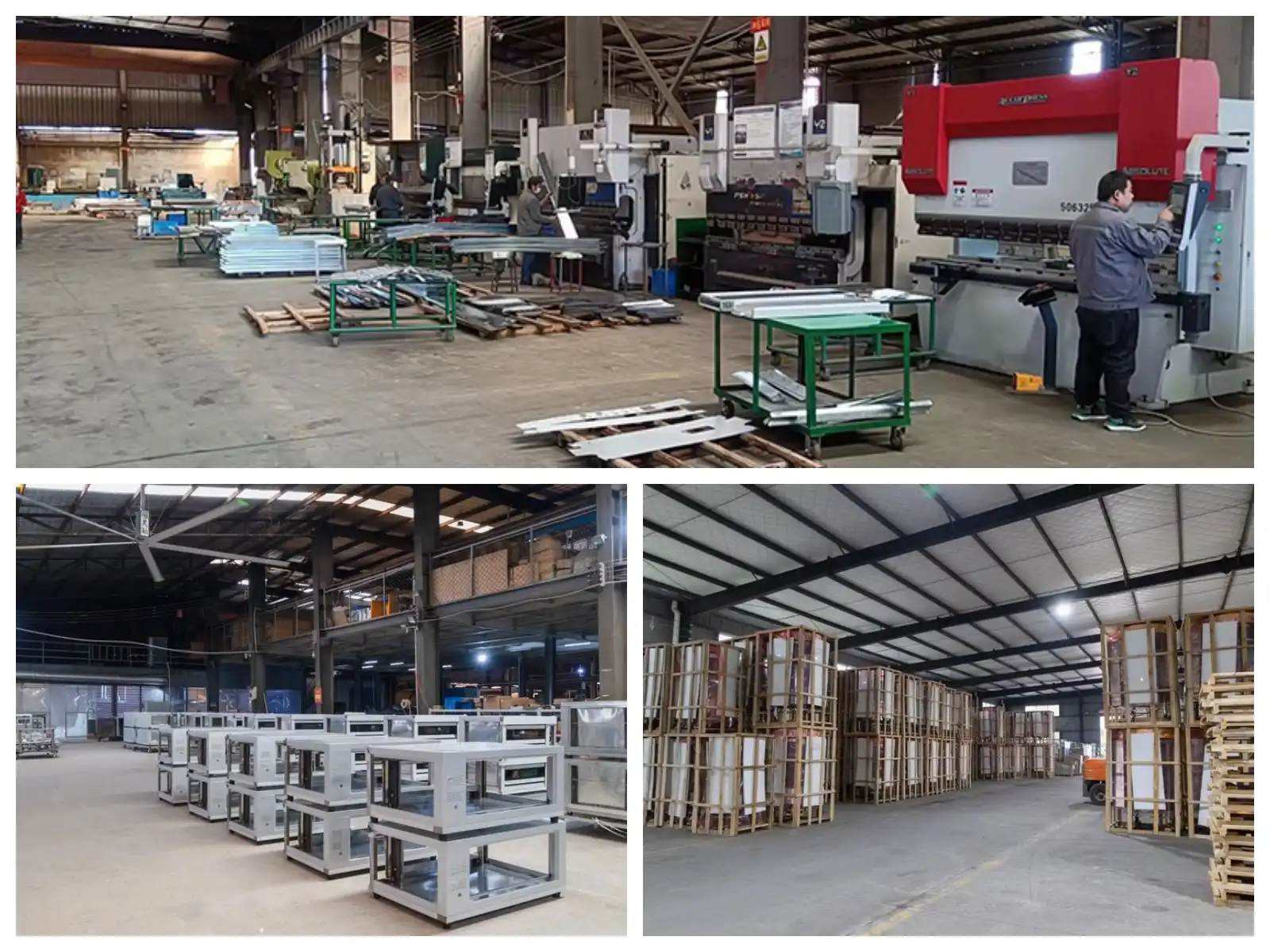
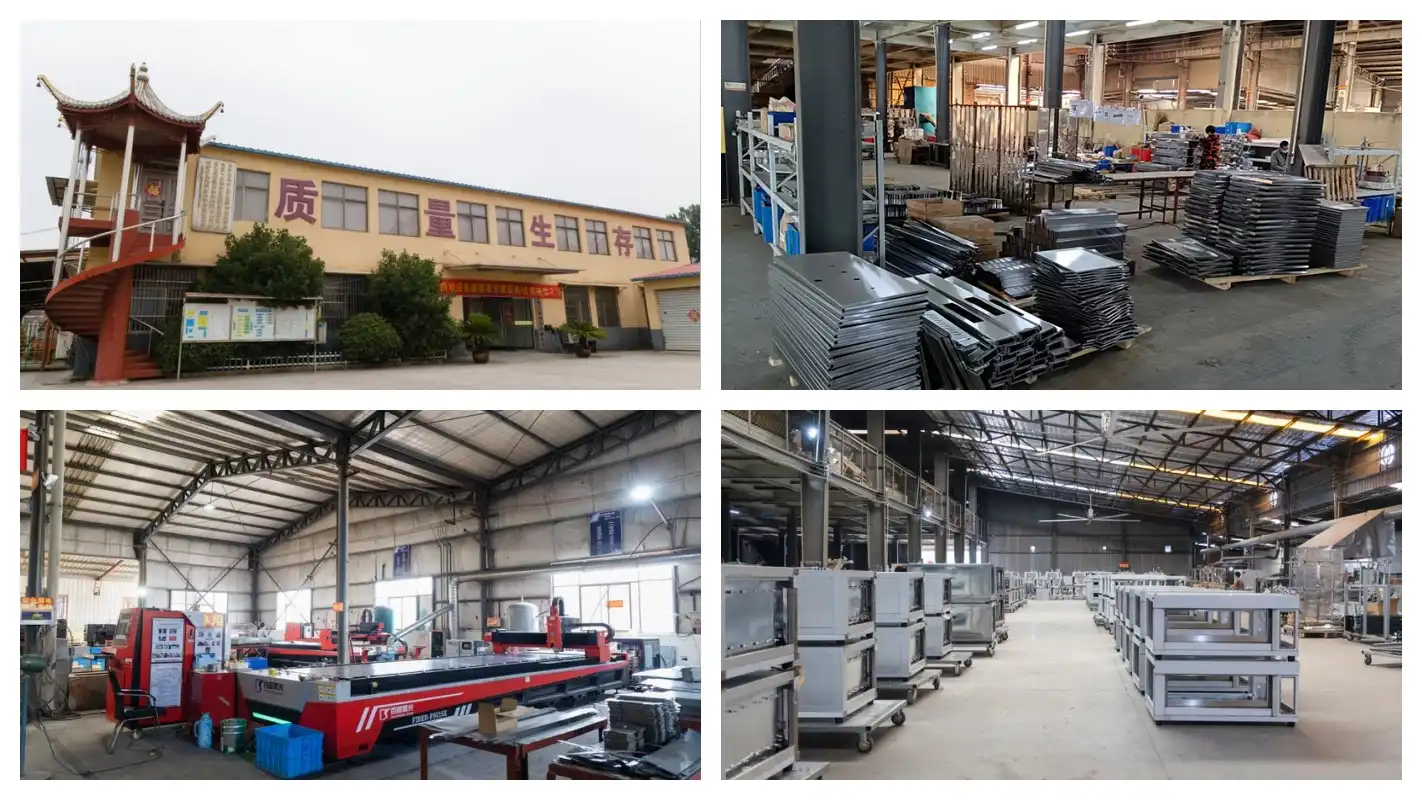
Before committing to any supplier, ensure the replacement parts — fan motors, door gaskets, control boards — are sent within a certain lead time. Suppliers who have worldwide logistical networks and defined testing processes, such as 48-hour burn-in testing under simulated convection electric oven commercial load, show that their quality process is repeatable. Insist on a parts catalog and mean-time-between-failure statistics for fan motors before signing a contract.
Procurement Strategies for Commercial Convection Ovens
“Just looking at a price list won’t be enough to get the right equipment. Experienced procurement directors usually do these things to develop a plan:
- First, review the compliance documentation. Ask for ETL / NSF / CE certifications before asking for a price. Certification gaps are 8-16 weeks longer to timetable, and a potential full re-sourcing cycle.
- OEM/ODM Terms: Request in writing. If your brand needs special exterior finishes, panel language, or voltage parameters (220V, 380V, or 415V), please indicate them in the first RFQ, not at the proofing stage.
- Landed cost, not merely FOB price, must be included. U.S. Section 301 tariffs on commercial kitchen equipment from China might add 7.5- 25% to your unit cost. Include this in your financial model prior to finalizing vendor selection.
Maintaining and Troubleshooting Your Commercial Convection Oven
The difference between equipment that lasts five years and equipment that lasts ten years is how often it is serviced.
Daily Cleaning Protocol
Use a stainless steel cleaner that will not damage the inside walls to clean after each shift. Remove the fan baffles and clean them once a week. If the baffles are obstructed, the airflow will be uneven, and the motor will be more stressed, which results in uneven browning. You should inspect the door gaskets for cracks on a daily basis. Damaged gaskets are a waste of energy and cause temperature fluctuations.
Preventive Maintenance Schedule
An expert should verify the calibration of the thermocouple every 90 days, using a certified reference probe. Listen for noise or vibration from the fan motor bearings. Make sure you hinge the door all the way down. Any gap larger than 2 mm may lead to a decrease in the chamber temperature during a 30-minute bake cycle. Write the date of each check as you complete maintenance. Many times warranty claims are rejected without documentation of service.
Common Issues and How to Address Them
If some trays are browning quicker than others, the fan motor or the grille is definitely damaged. If the temperature falls beyond or below the ±2°C range, there is an issue with either the thermometer or the PID system. Before contacting a professional, check the error code on the control panel in the repair instructions from the manufacturer. A managed power cycle may clear a number of error codes.
Conclusion
Before you purchase it for your company, you need to make sure that theconvection electric oven commercial 's output capacity, certification compliance, digital control accuracy, and source stability function well together. ETL/NSF papers are required for North America. For chains that transport a lot of items, having at least 6 trays and programming each deck independently preserves the quality of the commodities the same from batch to batch. The ability to adjust power and panel parameters to suit your market, quality testing that can be shown, and clear after-sales assistance should all carry greater weight. The correct equipment can assure the same high quality of items wherever you conduct business. Plus, you’ll save time on work and have fewer batches that don’t work out.
FAQ
1. Do I need ETL certification if the oven already has CE?
No. CE certification covers European market requirements. ETL and NSF/ANSI 4 are separate North American standards required for commercial kitchen equipment in the U.S. and Canada. Always verify the specific certification your local health department and insurance provider require before purchasing.
2. What temperature range do I need for a multi-product bakery?
A range from ambient (for proofing) up to 400°C covers the full spectrum — from dough fermentation at 35–40°C to high-temperature crust coloring at 230–260°C. Units like the SL-OKD3-6A cover this full span with independent controls per deck.
3. Is a 3-deck oven worth the investment for a 10-location chain?
Yes. A 6-tray production capacity per cycle reduces batch time and supports centralized baking for multi-location distribution. The per-unit labor cost drops significantly compared to running single-deck equipment across multiple shifts.
4. Can I customize the voltage for a U.S. installation?
Yes. Reputable suppliers offer 220V, 380V, and 415V configurations. Confirm your facility's electrical supply and request the correct specification in your purchase order.
5. How long does an initial procurement cycle typically take?
For first-time international orders, allow 12–16 weeks: certification document review, production lead time, ocean freight (approximately 35 days), and on-site installation and commissioning.
Get Your Custom Quote from Undermoon Today
For 20 years, Undermoon has been making industrial ovens. They can help people who need approved, large-capacity baking tools that can be changed in a lot of different ways. The SL-OKD3-6A is a reliable convection electric oven commercial option for bakery chains, central kitchens, and food service operators who need to keep output constant across multiple sites. Write to us to talk about your needs, get full information, or ask a question about buying in bulk.
Email address: undermooncn@gmail.com
References
1. ASHRAE. ASHRAE Handbook: HVAC Applications — Commercial Kitchen Ventilation. American Society of Heating, Refrigerating and Air-Conditioning Engineers, 2019.
2. NSF International. NSF/ANSI 4: Commercial Cooking, Rethermalization, and Powered Hot Food Holding and Transport Equipment. NSF International, 2023.
3. Intertek. ETL Listed Mark for North American Market Certification Requirements. Intertek Testing Services, 2022.
4. Food Service Technology Center (FSTC). Commercial Oven Performance Test Protocols and Energy Benchmarking. Fisher-Nickel Inc., 2021.
5. National Restaurant Association. NRA State of the Restaurant Industry Report: Equipment Procurement Trends. National Restaurant Association, 2023.
6. U.S. Trade Representative. Section 301 Tariffs on Goods from China: Commercial Kitchen Equipment Classifications. Office of the United States Trade Representative, 2023.
Online Message


