
Oct 8, 2026
How to Choose the Best Multifunctional Commercial Baking Oven for Your Business?
To pick the best multifunctional commercial baking oven, you need to know how much you can produce, look at technical specs like temperature accuracy and energy efficiency, check the manufacturer's references and certifications, and make sure they offer good customer service after the sale. The choice should weigh the initial cost against the benefits in running costs over time, with a focus on buying equipment that can precisely control the temperature, last for years of constant use, and be able to meet the needs of a wide range of baking needs, from bread and pastries to specialty items.send inquiry.
Understanding Multifunctional Commercial Baking Ovens
What Defines a Multifunctional Baking System
A multifunctional commercial baking oven has more than one way it can handle heat built into a single, well-designed platform. Instead of being single-purpose like most units, these systems have controlled steam input methods, forced convection technology, and radiant heating elements. With this combination, workers can bake a wide range of items, from crusty artisan loaves that need short bursts of steam to delicate pastries that need dry, gentle heat, all without having to switch out equipment.
The technical design is usually made of high-quality stainless steel and specialized insulation materials that keep the structure stable at temperatures ranging from room temperature to 400°C. Modern versions have PID controls that keep the temperature within ±1°C of what it should be. This meets the exacting standards of industrial recipe standardization. Fans with speeds that can be changed and an auto-reverse feature make sure that airflow is spread out evenly, preventing cold spots that affect the regularity of the product.
Core Technologies That Impact Performance
A big difference between industrial deck ovens and convection units is the humidity control technology. To keep the right amount of wetness in the dough during the baking cycle, professional-grade equipment either injects water directly or uses a stove to make steam. Direct injection systems give short bursts of steam that are great for making bread crusts, while continuous boiler systems support longer steaming times that are needed for some pastry applications and multi-phase baking processes.
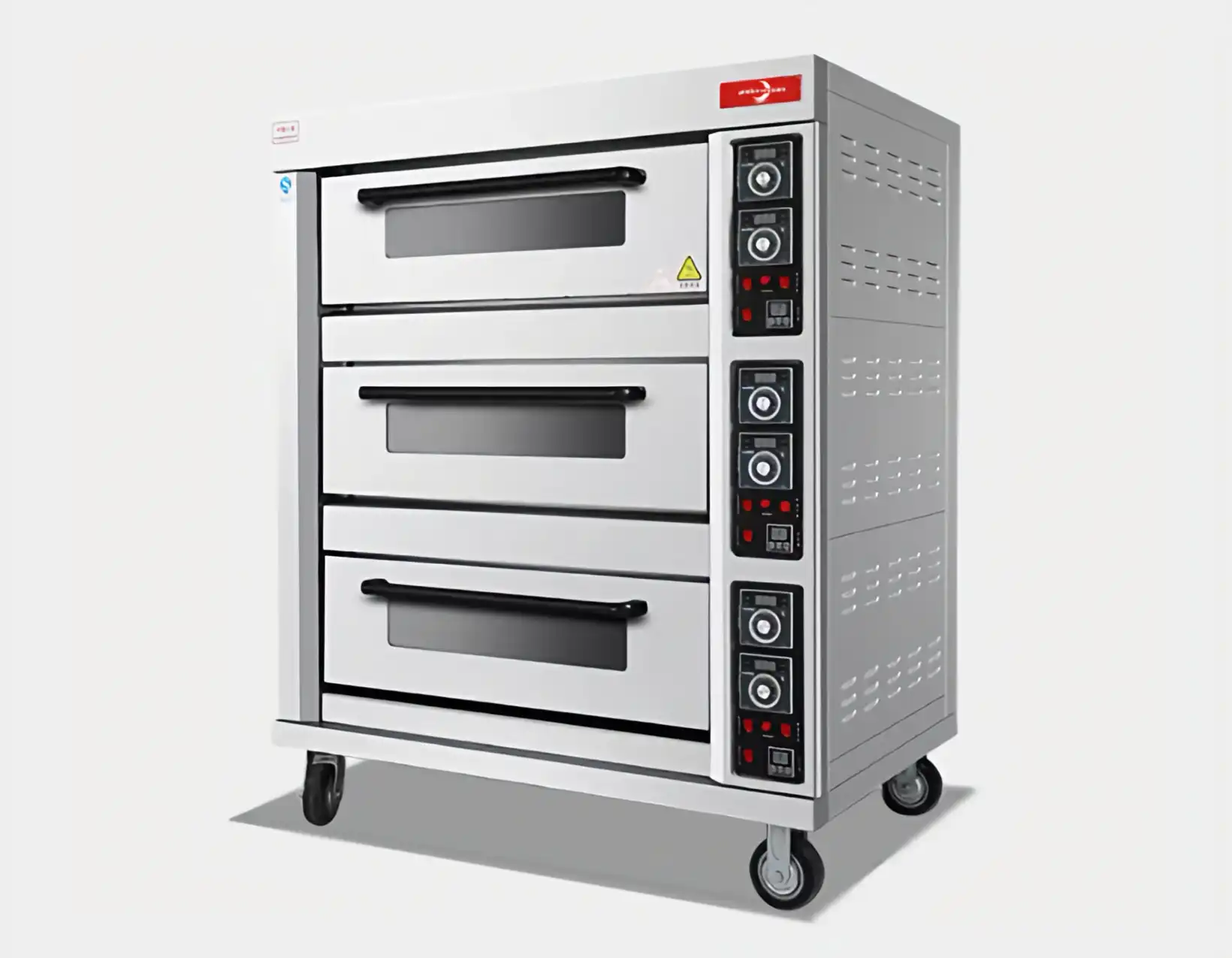
Temperature control tools have changed over time from simple mechanical timers to more complex systems that can be programmed. The SL-KXD3-9 type we make has mechanical knobs for setting the temperature and time, which makes it easy to use without losing accuracy. This method works well in situations where ease of use and dependability are more important than complicated code. This is especially true in places with a lot of staff change, where different shift workers use the same equipment.
Measures of energy economy have a direct effect on the costs of running a business. Insulation materials that are thicker keep heat in, which means that less power is used during long production runs. Triple-deck designs, like our 3-deck 9-tray electric oven, make the best use of vertical space while reducing floor space. This is important for bakers and kitchens in cities where rental costs are high for every square meter.
Applications Across Commercial Baking Segments
Bakery chains use these systems to make a lot of sourdough and pastries, and making sure that the recipes are the same at all of their sites is important for the brand's image. It is helpful for central kitchens that cater to institutions to be able to roast and steam food at the same time without taste transfer between racks. The flexibility of a single piece of equipment makes it easy for restaurant groups to switch between baking for breakfast, making food for lunch, and making pastries in the evening.
Key Factors to Consider When Choosing a Multifunctional Commercial Baking Oven
Assessing Production Capacity and Business Scale
Basic tool requirements are set by the amount of production that needs to be done. Industrial bakeries that process thousands of loaves every shift need different setups than small craft businesses that make 50 to 100 loaves every day. To figure out what your real throughput needs are, you have to look at your current production plans, find the slow spots, and guess how your business will grow over the next few years.
Output ability is directly related to how the decks are set up. Specialty businesses with low turnover can use single-deck units, while chain bakeries and food processing plants need triple-deck systems like the SL-KXD3-9 type for their batch capacity. With three separate decks that can each hold three trays, this setup lets up to nine full-size trays be baked at the same time, which is three times as productive as single-deck options without taking up as much floor room.
The sizes and capacities of the trays you use must match the products you sell. Standard setups work with a range of pan sizes, but making sure they are compatible with your individual baking vessels is the best way to avoid costly operating problems. Our mechanical control model's 1640x805x1500mm dimensions give it a large interior space while still having a small footprint that works with most industrial kitchen plans.
Energy Source Selection and Cost Implications
When choosing between electric and gas energy sources, there are different practical and financial issues to consider. Electric ovens let you precisely control the temperature, are easier to set up because they don't need gas lines, and can be used in places where gas service isn't available or is too expensive. Our electric deck oven's 380V, 29.7kW power rating works well for businesses that have enough electricity and stable energy rates.
In places where natural gas prices are low, gas-powered alternatives usually have lower operating costs. However, they are harder to install and may not be able to control temperatures as precisely as electric alternatives. We make multifunctional commercial baking ovens in both electric and gas models. To meet the needs of our customers and the standards of the utilities in their area, we can change the voltage, gas type compatibility, and control interfaces.
Energy economy certifications affect both running costs and environmental credentials, which are becoming more and more important in buying choices. Equipment that meets recognized energy standards lowers long-term power costs and supports companies' environmental promises, which buyers who care about the environment and B2B clients who are looking for supplier partnerships will appreciate.
Essential Technical Features and Safety Standards
Application variety is based on the temperature range that can be used. Our mechanical control oven can work at temperatures ranging from room temperature to 400°C. It can handle a variety of baking tasks, such as low-temperature proofing, normal bread baking at 200–230°C, and high-temperature pizza production that is getting close to full capacity. This range lets you offer a wider range of products without having to buy a lot of different units.
Technology for distributing heat has a direct effect on the precision of baking. Three-dimensional balanced heating systems make sure that all deck levels get the same amount of heat. This gets rid of the output difference that wastes energy and makes customers unhappy. Different goods can be baked at different temperatures at the same time thanks to independent deck controls. This is very important for businesses that need to manage a wide range of products during a single production run.
Safety factors keep people and things safe. Thickened heat protection keeps the outside from getting too hot and causing burn risks, while also cutting down on energy waste. The stainless steel structure makes it last longer and makes it easier to clean up so that food safety rules are followed. Meeting the requirements for CE, UL, ETL, and NSF approval shows that the equipment meets foreign safety and performance standards. This makes it easier for operators who serve multiple markets to follow the rules.
Comparing Multifunctional Commercial Ovens with Traditional Baking Ovens
Versatility and Performance Consistency
Traditional ovens that only do one thing well are great at certain jobs, but they make it hard to grow a business's product line. By getting rid of the need for multiple pieces of equipment, multifunctional commercial baking ovens let businesses add new product lines without having to spend money on buying more specialized units. This freedom is especially helpful for companies that want to see how the market reacts to unique products before committing to dedicated production lines.
Consistency in performance across product types gives a business an edge in markets where maintaining consistent quality is key to keeping customers. Being able to follow pre-programmed baking protocols makes sure that goods meet specifications no matter who operates the equipment or which shift does the work. This is especially important for chain operations that need to keep brand standards across multiple sites.
Durability and Maintenance Requirements
Commercial-grade construction decides how long tools will last when it is used a lot. Our bodies are made of stainless steel and have reinforced insulation to keep up with the physical and chemical stresses of ongoing industrial use. Failure rates that disrupt production plans and cut into profits through emergency repair costs can be cut down by choosing parts that are proven to last longer rather than those that are the cheapest.
Total cost of ownership is affected by how easy it is to do maintenance. Equipment that is made for simple cleaning and regular service increases the life of the machine and lowers the level of technical knowledge needed for basic maintenance. Compared to digital interfaces, mechanical control systems are naturally simpler. This means that they have fewer possible failure spots and can be fixed with standard parts that can be found through a variety of supply channels.
Protocols for preventive repair make things more reliable. Heating elements, door seals, and fan systems can be found to be worn before they break when they are inspected regularly. Our 20 years of experience in manufacturing help us make design decisions that reduce common failure modes. For example, we use reinforced hinges that can withstand more than 50,000 cycles and door seals that are easy to repair and keep the equipment's heat efficiency throughout its life.
Cost Analysis and Return on Investment
The initial cost of cash is only one part of the total cost of ownership. Multifunctional stoves cost more than basic traditional units, but this difference should be weighed against the time and money saved on running multiple specialized tools and the benefits of being able to do more than one thing. When you do a full ROI estimate, you take into account things like lower energy costs, less work for employees because of fewer machines, and higher sales from more products that can be made.
Patterns of energy use have a big effect on running costs over the usual 10 to 15-year life span of equipment. Thicker insulation and precise temperature control cut down on heat loss and overshooting, both of which waste power. Even small gains in efficiency add up to big savings on energy costs over thousands of hours of operation every year. This shortens the time it takes to get the money back and increases long-term profits.
The costs of downtime often go over the prices of repairs. When equipment breaks down during busy production times, it leads to missed delivery dates, wasted ingredients, extra work, and a loss of customer happiness. Investing in manufacturing quality that has been proven to work and strong construction lowers the number of failures. This protects your most valuable business assets, like income streams and your brand's image.
Procurement and Vendor Selection: Making an Informed Purchase
Evaluating Manufacturer Credentials and Reputation
Manufacturing experience is closely linked to knowing how to use a product and how reliable it is. Our 20 years of experience making multifunctional commercial baking ovens shows that we are committed to the business and not just jumping into the market when we see an opening. This length of time means that supply lines have been set up, manufacturing processes have been improved, and the company has gained the experience to deal with real-world operational problems that younger manufacturers haven't yet seen.
Production skills show how well they can meet your needs. Standardized production facilities with structured quality control methods make sure that all of the equipment is the same. This is very important for chain operations that buy multiple ovens and expect them to all work the same. Our mature quality management systems oversee every step of the production process, from finding the parts to the final inspection in the plant. This gives businesses the security they need.
Your ability to keep working when problems happen depends on your technical help system. Manufacturers who offer quick contact, thorough paperwork, and easy access to spare parts stocks keep operations from being interrupted as little as possible. When looking at possible providers of multifunctional commercial baking ovens, make sure to check how responsive their technical team is and how committed they are to supporting equipment for as long as it is in use.
Certification Verification and Compliance Requirements
Independent tests are used to back up promises of safety and efficiency in international certifications. The CE label shows that the product meets the rules of the European Union, and the UL and ETL listings show that it meets the safety standards of North America. NSF approval talks about how to keep food tools clean. The equipment with these marks has been through a lot of testing, which lowers your risk of liability and makes it easier for health and safety officials to check your facility.
Regional differences in regulations require the ability to be customized. Different national standards call for different power levels, control interfaces, and safety features, which we can easily add to our manufacturing process. This customization knowledge is especially useful for wholesalers that work with a lot of different markets and businesses that want to grow internationally because standardizing equipment makes training and servicing go more smoothly.
After-Sales Support and Service Infrastructure
Warranty coverage shields the original investment and shows that the maker trusts the quality of the product. Comprehensive guarantees that cover major parts and work for long periods of time lower financial risk during the initial stages of business, when equipment validation is happening. Knowing the limits of the guarantee, how to file a claim, and how quickly the service will respond can help avoid confusion that can cause problems when support is needed.
Availability of spare parts decides whether repair is possible and how long the downtime will last. Manufacturers who keep enough spare parts and consumables on hand can make fixes quickly, which keeps production from stopping too often. When looking at makers of multifunctional commercial baking ovens, find out if parts are available, how long it takes to deliver, and if the company supports equipment for as long as it lasts or stops supporting older models.
The level of technical support changes a lot between suppliers. When we troubleshoot, our team uses decades of experience with applications to help customers improve working settings, answer questions about installation, and quickly fix performance problems. This knowledge is especially useful when setting up new tools and when working needs change and configuration or process improvements are needed.
Pricing Strategies and Logistics Considerations
Pricing that is clear makes it easier to make smart decisions. We give thorough quotes that list the specs of the equipment, the features that come with it, and any upgrades that are available. This makes it easier to make a budget and avoids surprises that can slow down the approval process for a project. Discounts for buying in bulk for multiple units help with chain growth and distributor stocking needs while also making the project more cost-effective.
For foreign buying, how quickly a container is loaded is important. Our knowledge of how to best package items for sale cuts down on freight costs and the chance of damage during transport. Figuring out the limits of size and how heavy things are helps make sure that shipping plans are in line with how the equipment actually works. This keeps problems from happening that could push back the deadline for a project.
Delivery lead times need to be thought about early on in the planning process. Custom designs, especially OEM/ODM orders with specific voltage, control interface, or aesthetic needs, make production take longer than when standard models are available. Setting realistic deadlines during the planning phase of buying keeps people from making hasty choices and allows for the manufacturing precision that makes sure delivered equipment meets specifications.
Practical Tips and Best Practices for Operating Your Multifunctional Commercial Baking Oven
Maintenance Protocols and Equipment Longevity
Cleaning multifunctional commercial baking ovens on a regular basis keeps them safe for food and extends their life. As part of daily operations, crumbs should be removed, surfaces should be kept clean, and the outside should be cleaned with industrial cleaners that are safe for stainless steel surfaces. Deep cleaning the inside surfaces, door seals, and air parts once a week stops buildup that lowers the energy efficiency and makes the home more fire-prone.
Schedules for preventive inspections find problems before they get worse. Regular monthly checks of the state of the heating elements, the accuracy of the temperatures using calibrated thermometers, and the integrity of the door seals catch damage early, when it's still easy and cheap to fix. Professional service inspections done once a year by trained experts check all of the electrical systems, mechanical parts, and safety features.
Replacing a part with a real one keeps the original performance specs. Even though aftermarket parts might be cheaper, problems with fit and poor-quality materials can make them less safe and void guarantees. Our promise to keep parts available throughout the lifecycles of our products means that users can always find genuine spare parts that will keep their equipment working well for a long time.
Safety Compliance and Operator Training
Accidents can be avoided by teaching employees safe ways to do their jobs. A full introduction that covers how to start up, set the temperature, and shut down in an emergency, as well as being aware of hazards, lowers the risk of injury and equipment damage from wrong operation. Proof of training completion helps with following the rules and shows that safety management at work is done properly.
Regular checks of safety features should happen. People and property are kept safe by checking that temperature limit controls work properly and that emergency stopping mechanisms work as intended. Door locking systems that stop opening during high-temperature operation are also tested. These checks are quick and easy, but they keep big problems from happening that could hurt someone or put you at risk of being sued.
Energy Optimization Techniques
Operational methods have a big effect on energy use that goes beyond how efficient the multifunctional commercial baking oven itself is. Preheating only to needed temperatures instead of full capacity, planning production to run continuously instead of switching between on and off cycles often, and filling ovens to full capacity instead of in batches that aren't full all help save energy without lowering the quality of the products.
Temperature recovery tracking shows how efficiency drops over time. If the warming time is longer or the temperature returns more slowly after the door is opened, it could mean that the insulation is wearing out, the heating elements are failing, or the door seal is leaking. Dealing with these problems right away improves efficiency and stops damage from getting worse over time, which would eventually require major fixes or replacement before its time.
Conclusion
To choose the best multifunctional commercial baking oven, you need to carefully consider your production needs, technical specs, the manufacturer's reputation, and the total cost of ownership. The choice will affect how efficiently your baking business runs, how consistent your products are, and how much money it makes in the long run. You can build a foundation for long-term business success by focusing on proven manufacturing quality, full after-sales support, and equipment built to meet the needs of your particular purpose. We can help you make the right choice because we've been making industrial baking equipment for 20 years and can offer customization options, technical know-how, and reliable performance that businesses count on every day.
FAQ
What distinguishes multifunctional commercial ovens from traditional models?
Multifunctional commercial baking ovens combine different cooking methods and control options into a single unit. This lets them be used for a variety of baking tasks without having to change the equipment. Traditional ovens are usually only good for one thing and can't be used in a lot of different ways. As a business's product line grows, it has to buy more specialized ovens.
How do I determine the appropriate capacity for my operation?
Figure out your daily production peak, take growth estimates into account, and then match that number to the size of your oven trays and the time it takes to cycle batches. Large bakeries and central kitchens that make a lot of food can use the 3-deck 9-tray arrangement. Smaller businesses, on the other hand, may need different deck layouts that fit their throughput needs.
Are electric or gas ovens more energy-efficient?
How efficient something is based on the energy rates and how it is used in that area. Electric models, like our SL-KXD3-9, offer precise temperature control and easier installation. Gas models, on the other hand, may have lower operating costs in places where natural gas prices are high. When properly set up for your program, both choices give you good performance.
What certifications should I require from manufacturers?
Certifications like CE, UL, ETL, and NSF prove safety and performance through independent testing. This makes following the rules easier and lowers your risk of being sued. The equipment that has these marks on it has to meet strict international standards for electricity safety, materials that come into touch with food, and stability of operation.
Partner with Undermoon for Your Commercial Baking Equipment Needs
Undermoon gives 20 years of specialized manufacturing experience to business bakeries all over the world. As a well-known company that makes the multifunctional commercial baking oven, we offer the technical accuracy, customization options, and quick support that operations directors and buying managers need. Our electric and gas series commercial ovens go through strict quality control checks at every stage of production. This makes sure that they are stable and last a long time, which is important in high-traffic business settings. Contact our team at undermooncn@gmail.com to talk about your unique production needs. You can also look at our full range of products, which includes the SL-KXD3-9 model, and learn how our OEM/ODM services can help you get equipment that fits your needs and your place in the market.
References
1. Johnson, M. & Williams, R. (2022). Commercial Bakery Equipment Selection and Operational Efficiency. International Journal of Food Service Technology, 57(3), 412-428.
2. Thompson, K. (2021). Energy Efficiency Standards in Commercial Kitchen Equipment. National Restaurant Association Educational Foundation Press.
3. Chen, L., Roberts, P., & Martinez, J. (2023). Thermal Management Systems in Professional Baking Operations. Food Equipment Manufacturing Quarterly, 18(2), 67-84.
4. Anderson, S. (2022). Procurement Strategies for Large-Scale Food Service Operations. Commercial Kitchen Management Review, 31(4), 156-173.
5. Peterson, D. & Kumar, A. (2023). Quality Control Protocols in Commercial Oven Manufacturing. Industrial Baking Technology Journal, 44(1), 92-108.
6. Williams, T. (2021). Multifunctional Cooking Equipment: Design Principles and Performance Evaluation. Professional Foodservice Equipment Association Technical Bulletin, 12(3), 34-51.
Online Message
YOU MAY LIKE
High quality furniture manufacturer


