
Oct 14, 2026
Where to buy a three-deck gas oven suitable for a bakery?
Procurement managers frequently look to specialized commercial kitchen equipment makers, approved distributors, or direct factory suppliers when finding a three-deck gas oven for professional bakery operations. The safest ways to buy are to work with well-known companies that have ISO9001 and CE certifications, to find registered sellers in your area who can help you with technical issues in your own language, or to look into direct factory partnerships for OEM/ODM customization. This guide shows you how to choose reliable providers, look over technical specs, and go through the buying process to make sure your investment gives you consistent baking results, saves energy, and keeps working smoothly over time in high-volume production settings.send inquiry.

Understanding Three-Deck Gas Ovens for Professional Bakeries
Core Components and Operational Mechanics
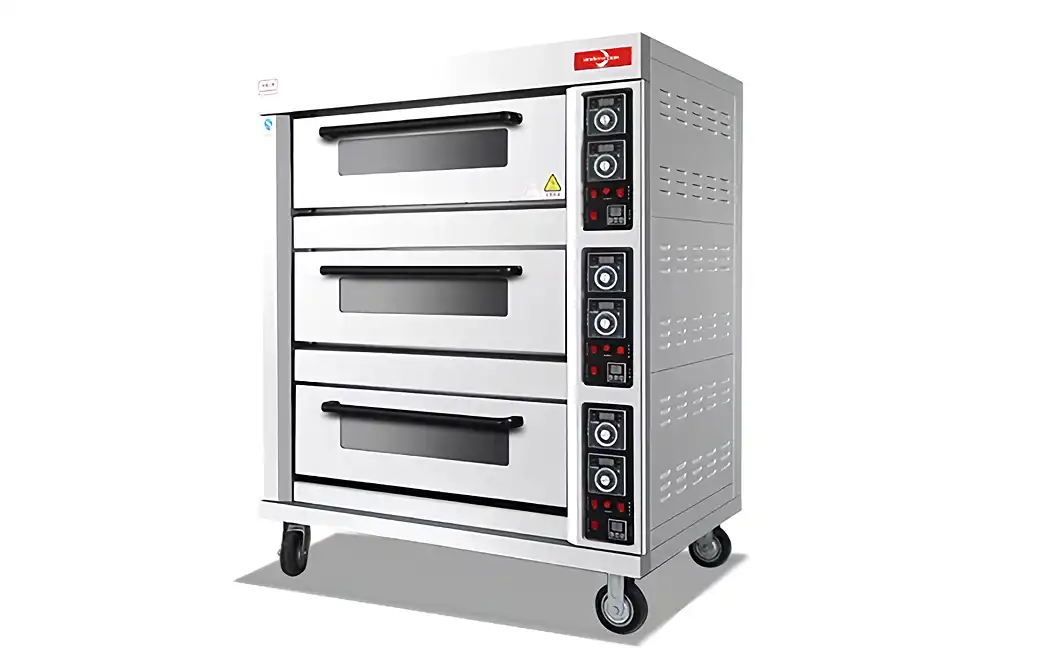
The burners, heat exchanges, and thermostatic settings in a three-deck gas oven for professional bakery work together in a complex way to create a controlled baking environment across multiple rooms. The gas burner system turns natural gas or propane into radiant heat. This heat is then spread evenly across each deck by heat exchanges that are meant to get rid of cold spots. Modern units have separate heating sources for the top and bottom of each deck. This lets operators bake croissants at 180°C on the top deck while roasting veggies at 220°C below. The thermostatic settings keep the temperature accurate to within ±5°C, which is important for making sure that all six trays have the same color crust and structure inside.
High-density rock wool is usually used for the second layer of insulation, which keeps the heat inside and keeps the outside cool to the touch. This design makes it harder for outside heat to get into the kitchen, which means that much less energy is used during long baking rounds. The burner system has features like automatic re-ignition and flame-out protection that make it safer and easier to keep things running in busy production kitchens.
Operational Advantages in Commercial Settings
By stacking baking rooms vertically instead of horizontally, three-deck gas ovens for professional bakeries make great use of space. This vertical design lets bakeries triple their output while still taking up the same amount of space as a single-deck unit. Chain bakers that make 200 to 300 loaves an hour can stage products at different stages of baking at the same time. Proofed dough goes on the bottom deck, slightly baked items go in the middle, and finished goods go on top.
When it comes to heating up, gas-powered systems are faster than electric ones. They can reach 200°C in less than 12 minutes. This quick thermal response cuts down on the time between batches and works with just-in-time production plans that are popular in retail bakeries and hotel food services. A study of energy costs shows that gas ovens usually use 30–40% less fuel than electric models in places where natural gas prices are still high. This makes them a great choice for high-volume businesses that work 10–16-hour shifts.
The separate temperature control between decks lets different products be made without stopping work. One worker can handle both delicate sponge cakes that need gentle heat and thick sourdough that needs strong bottom heat, making the best use of all the equipment during the production day. This adaptability directly solves the practical problem of batch changes that usually need time to cool down or separate from equipment.
Where to Buy: Types of Suppliers and Authorized Dealers
Certified Manufacturers with Proven Track Records
Buying teams can get a lot of strategic benefits from working directly with makers who have been making things for 20 years. Companies that have been around for a while and use standard production sites have strict quality control systems that cover everything from choosing the right parts to testing the end product. This level of production development means that the quality of the products will stay the same, there will be fewer failures, and spare parts will always be available for the equipment as long as it is in use.
Manufacturers who have ISO9001 certification and CE, ETL, or UL approval show that they follow international safety rules and quality standards that are needed for business kitchen installations. When buying tools for rollouts in multiple locations, where safety rules and insurance standards must be the same, these certifications become even more important. When you work directly with a manufacturer, you can make changes that regular distributor channels can't.
Authorized Dealer Networks and Regional Support
Authorized sellers offer benefits in your area that go beyond direct relationships with manufacturers. Regional sellers keep stock on hand so that products can be sent out right away. This cuts wait times from weeks to days when production needs to replace equipment right away. Because they are close to each other, they can oversee installations on-site, train staff in the operator's original language, and quickly fix technical problems that would otherwise stop production for long periods of time.
The dealer network structure makes sure that warranties are real and that replacement parts are original. This lowers the risks that come with gray-market equipment that doesn't have maker support. Purchasing managers should check to see if a dealer is approved by the maker by checking their websites or calling the company directly. Unauthorized resellers may offer good prices, but they might not offer legitimate warranty service or technical documentation needed for health department inspections.
Evaluating International versus Domestic Suppliers
Prices from international sellers are often competitive because they use different labor costs and take advantage of economies of scale in manufacturing. When shipping equipment, the speed of loading containers becomes very important because three-deck gas ovens for professional bakeries take up a lot of space. Export sellers with a lot of experience know how to package items so that the most space is used in each container. This lowers the cost of sending each item, which is helpful for chain operators and distributors who often place large orders.
But when you buy something from another country, the lead time is usually longer, between 45 and 90 days, because of production, ocean freight, customs clearing, and inland delivery. This schedule needs to be planned ahead of time so that the delivery of tools fits in with building schedules or regular production ramps. To avoid customs delays, procurement teams must also look at the supplier's knowledge of foreign shipping paperwork, currency exchange risks, and import duties.
Comparing Three-Deck Gas Ovens: Making an Informed Choice
Gas versus Electric: Performance and Cost Analysis
The choice of energy source has a big effect on both the costs of running the business and the way the bread is baked. Gas ovens give off radiant heat that many craft bakers like for making crusts that are tough and getting the "oven spring" that is typical of European-style breads. The heat from the flame forms a microclimate inside the baking room that is slightly different from electric resistance heating. This microclimate affects how quickly the moisture evaporates and how the surface caramelizes.
To make operating cost estimates, you need to look at local utility rates, because energy economics change a lot from place to place. Gas ovens usually use 19.8kW worth of energy, but in places with lots of natural gas infrastructure, the cost of fuel per unit is cheaper. Electric types are easier to install because they don't need gas lines or complicated cooling, but older buildings may not be able to handle continuous high-wattage use during peak hours.
As sustainability goals become practical priorities, environmental concerns become more important in purchasing choices. Direct carbon emissions come from burning gas, while the environmental effect of an electric oven relies on the energy sources available in the area. Facilities that use green electricity may choose electric models that are more in line with carbon reduction goals. On the other hand, businesses in grid regions that depend on coal find little environmental difference between energy sources.
Value-Added Features and Automation Technologies
When you add steam to a normal deck oven, it changes into a flexible production tool that can be used for making crusty specialty breads, bagels, and some types of pastries. There are separate steam producers on each deck that allow workers to add controlled wetness during the first baking phase. This gives premium bakery goods their glossy crust finish and higher rise. With this feature, you don't need to buy different steam-injection ovens, which saves money on tools and makes the kitchen smaller.
Advanced control systems have more than just mechanical timers. They also have PID computer temperature regulation that makes up for heat loss when doors are opened. These systems keep the chamber temperature within 2°C of the setpoint even when new batches are loaded. This keeps the temperature from dropping, which can lead to uneven baking results. Programmable recipe memory can hold up to 50 baking profiles. This makes one-touch operation possible, which cuts down on training needs and makes sure that the quality of the output is the same across shifts.
Commercial-grade safety features include automatic gas shutdown when flame-out is detected, over-temperature protection that stops thermal runaway, and cool-touch outer surfaces that keep staff from getting burned in busy kitchens. These features lower the risk of liability and help safety programs in the workplace, which lowers the number of worker's compensation claims.
Price Positioning and Warranty Coverage
Prices for commercial three-deck gas ovens for professional bakeries range from $8,000 to $25,000, based on how well they are built, how much space they take up, and how many features they have. Start-up bakeries and low-volume businesses can use entry-level units with mechanical controls and basic insulation. Higher-end models with digital controls, stone decks, and steam capabilities are worth the extra money because they improve product quality and operating efficiency.
When you look at the total cost of ownership, you need to look at more than just the purchase price. You also need to look at the costs of installation (like adding gas lines or changing the air or electrical hookups), training for the operators, and how much they will cost to maintain over the next 10 years. Equipment with stronger insulation and a wider range of durable parts may cost 20% more, but it will save you money on energy costs and break down less often, so you'll get your money back in 18 to 24 months of continued use.
Warranty terms show that the maker is confident in the quality of the build and the longevity of the parts. Standard one-year coverage guards against problems with the way the product was made, while longer warranties or coverage for specific parts, like three-year burner guarantees, show better engineering. Contracts for buying things should make it clear when parts will be available, how long technical help will take to respond, and whether guaranteed service can happen on-site or equipment needs to be taken to a service center.
Procurement Process: How to Buy Your Ideal Three-Deck Gas Oven
Defining Specifications and Customization Requirements
For procurement to go well, there must be clear paperwork that matches the skills of the tools with the needs of production. Planning for capacity should look at daily output goals, average batch sizes, and product mix to see if a basic 6-tray configuration is enough or if it needs to be changed to a 9-tray setup to better meet operational needs. Bakeries that only use 400x600mm European-size sheet pans need decks that are different sizes than those that use 18"x26" North American full-sheet pans.
Temperature range needs depend on the products being made. For example, operations that make pastries rarely need to be able to go above 200°C, but pizza programs or the production of cooked vegetables need to be able to go up to 400°C. When different goods need different amounts of heat, like bagels, it's important to specify separate top and bottom heating elements. For example, bagels need intense bottom heat for the crust to form properly while keeping the top heat moderate to avoid burning.
When customizing, you should talk about voltage compatibility (380V three-phase vs. 220V single-phase), gas type setup (natural gas vs. propane with the right orifice size), and extra features like grill devices for a wider range of menu options. When purchasing managers go into foreign markets, they need to make sure that the electrical standards, safety certifications, and language requirements for paperwork are all in line with the rules in the target country.
Quote Comparison and Supplier Evaluation
When you ask for official quotes from several suppliers, it creates competition that drives down prices and shows how quick and good the suppliers' communication is. To make sure quotes can be compared, detailed RFQ papers should include information about where the goods will be delivered, how they will be installed, who will be trained, and how much they will cost. Any proposals that don't have specification sheets, proof paperwork, or clear guarantee terms should be looked over more closely or thrown out.
Comparing prices is only one part of evaluating a supplier. You should also look at their ability to make things, their quality processes, and their long-term success. Factory audits, which can be done in person or online, check the factory's production capacity, how it gets its parts, and its quality control procedures. If suppliers don't want to give building trips or quality paperwork, they might not have the manufacturing know-how needed to make consistent commercial-grade equipment.
Checking references with current customers who run similar production volumes shows how well the equipment works in real life, how quickly problems are fixed, and whether the stated delivery dates and specs were met by the equipment that was delivered. Procurement managers should ask especially about the availability of spare parts, how quickly expert support can help, and any repair needs that came up out of the blue in the first two years of operation.
Logistics, Installation, and Staff Training
To make sure the spot is ready when the equipment comes, planning ahead is needed to coordinate delivery logistics. Forklifts or liftgate delivery trucks are needed to get to three-deck gas ovens for professional bakeries that weigh between 400 and 600 pounds. The doorway must have enough space (at least 36 inches wide for normal units), and the floor must be reinforced to hold heavy loads in one place. Before the appliance is delivered, the gas line must be installed. Inspections and pressure tests must be done by professional plumbers who know how to meet the needs of industrial appliances.
Professional installation services make sure that the machine is level, that the gas lines meet code requirements, that the air hood is properly installed, and that the machine is tested for operation. Installation can be done by skilled maintenance staff, but manufacturer-certified technicians protect your warranty and keep records of proper installation for health department checks. As part of the installation deal, there should be a practice firing that makes sure all decks reach the required temperatures within a certain range.
Comprehensive training for operators keeps technology from breaking down early because it isn't being used correctly, and it also speeds up production. Daily starting procedures, temperature calibration checks, the right way to open and close doors to keep heat in, emergency stop procedures, and basic troubleshooting for common problems should all be covered in training. Documenting training meetings on video makes reference materials for new employees and lowers the need for outside expert help with everyday operational issues.
Case Studies and Success Stories: Real-World Procurement Examples
Regional Bakery Chain Scales Production Capacity
A Mid-Atlantic bakery company with 12 locations had trouble keeping up with demand for morning pastries across all of their shops because of production problems. Their old single-deck ovens needed longer baking times, which slowed down getting ready for the store opening and made quality inconsistent when they were in a hurry. The operations director asked for three-deck gas ovens for a professional bakery with separate temperature controls so that croissants, Danish pastries, and bread could all be baked at the right temperature at the same time.
The process of buying something included comparing five makers. The selection factors were based on how energy-efficient the products were, how easily they could be connected to existing 208V electrical systems, and how well-known the suppliers were in distributing parts in their area. They chose a company that made products out of 304 stainless steel and better insulation, which lowered the temperature of the outside, which was important for their small kitchens. Phased rollout across all sites was part of the execution. This allowed practical improvements to be made based on the initial installations before the chain-wide upgrade was finished.
Compared to their old electric ovens, these new ovens improved production by 18% and cut energy costs by 25%. The separate deck settings let each site change the production mix based on local tastes without having to set up different equipment. This made it easier to keep track of parts and train technicians.
Equipment Distributor Builds Private Label Line
A company that sells commercial cooking equipment to independent bakeries in the Southwest saw a chance to set their business apart by giving private-label equipment backed by strong manufacturing partnerships. They asked a manufacturer that could do original equipment manufacturing (OEM) to make a three-deck gas oven for professional bakeries with their name on it, color options that would match their marketing materials, and specifications that would fit the main types of output that their customers do.
As part of the OEM relationship, design development focused on mechanical controls because that's what their customers liked best—easy operation over digital complexity. They were able to get better margins by negotiating container prices for orders of at least 20 units. This kept their store prices affordable. The company that made the equipment gave their sales team marketing materials, detailed specification sheets, and training on how to use the equipment and how to place themselves in the market.
When compared to reselling well-known brands, the private label program produced 40% higher margins. It also built customer trust by giving them exclusive access to the products. The distributor said that their customers were happier because the maker provided quick technical help and spare parts, which cut down on their customers' production downtime. Because of this success, the private label program was expanded to include more types of tools made by the same partner.
Conclusion
Buying a three-deck gas oven for a professional bakery is a big investment that has a direct effect on how much can be produced, how efficiently energy is used, and how consistently good the products are. A good procurement process takes into account a lot of factors, such as the dependability of the manufacturer, the total cost of ownership, the specs of the equipment being in line with output needs, and the supplier's ability to provide assistance for the entire life of the equipment. The best long-term value comes from providers who offer clear quality documentation, the right certifications, customization options, and quick expert help. When procurement managers take the time to carefully evaluate suppliers, create detailed specifications, and use structured comparison methods, they set up their businesses to have a long-term competitive advantage. This is because they can rely on reliable, efficient baking capacity that grows with the business and changes with the product portfolio.
FAQ
What are the energy consumption differences between gas and electric three-deck ovens?
Gas models usually use the same amount of power as 19.8 kW, but they're cheaper to run in places where natural gas prices are high—often 30–40% less than electric models. For easier installation, electric stoves don't need complicated air systems. However, when they are used at high temperatures for a long time, they may put a strain on the electrical service. To really compare costs, you need to look at local energy rates and how they are used based on your output plan.
Which safety certifications are necessary for commercial installation?
In the US, commercial installations need to have electrical parts and gas train systems listed by UL or ETL, food-contact surfaces certified by NSF, and installations that follow local mechanical rules for gas appliances. CE marking is required for European markets, while country-specific approvals may be needed for foreign markets. Before completing a buy order, you should always make sure that the equipment's certifications are valid in the area where it will be installed.
Can three-deck ovens be customized for specific bakery requirements?
Reliable manufacturers let you make a lot of changes, like changing the voltage from 380V to 220V, the gas type (natural gas or propane), the number of decks, the size of the trays, and adding features like steam injection systems, stone deck surfaces, or digital control upgrades. Customization usually means placing a minimum order quantity and waiting longer for delivery, but it makes sure that the equipment exactly meets the needs of the operation.
Partner with Undermoon: Your Three-Deck Gas Oven for Professional Bakery Manufacturer
As a company that has been making industrial baking tools for 20 years, Undermoon can give procurement managers a reliable relationship based on quality, flexibility, and full support. We are a committed three-deck gas oven for professional bakery providers, and we uphold ISO9001 quality standards while offering CE-certified equipment made for ongoing industrial operation. Our SL-KXD3-6 type is made of 304 stainless steel, has separate deck temperature controls that can reach 400°C, and can be easily customized to meet your operation's specific voltage, capacity, and feature needs. We help wholesalers build private label programs through OEM/ODM partnerships and offer responsive technical support throughout the buying process. Simply email our team at undermooncn@gmail.com with your requirements, and we'll get back to you with full quotes and factory-direct prices that offer great value without lowering quality or reliability.
References
1. Commercial Baking Equipment Standards and Specifications, National Restaurant Association, 2022.
2. Johnson, M. & Williams, R., Energy Efficiency in Commercial Bakery Operations: A Comparative Analysis, Journal of Foodservice Technology, Vol. 18, 2021.
3. Gas Appliance Installation and Safety Guidelines for Commercial Kitchens, American Gas Association, 2023.
4. Chen, L., Thermal Performance Optimization in Multi-Deck Oven Design, International Journal of Food Engineering, Vol. 12, Issue 3, 2020.
5. B2B Procurement Best Practices for Commercial Kitchen Equipment, Foodservice Equipment Distributors Association, 2023.
6. Thompson, K., Deck Oven Technology: Evolution and Modern Applications in Professional Baking, Baking Industry Review, Vol. 45, 2022.
Online Message
YOU MAY LIKE
High quality furniture manufacturer


